

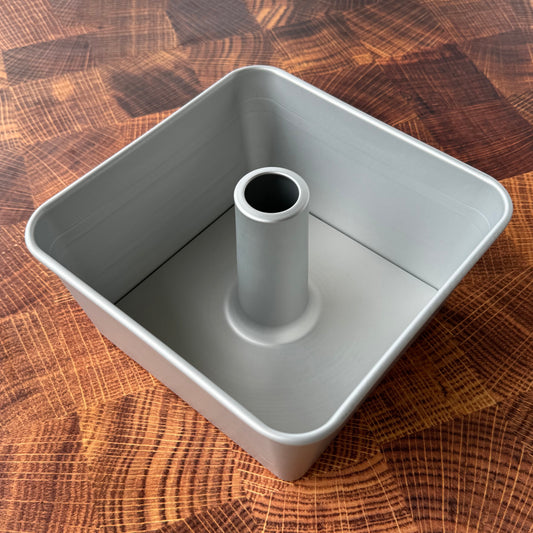
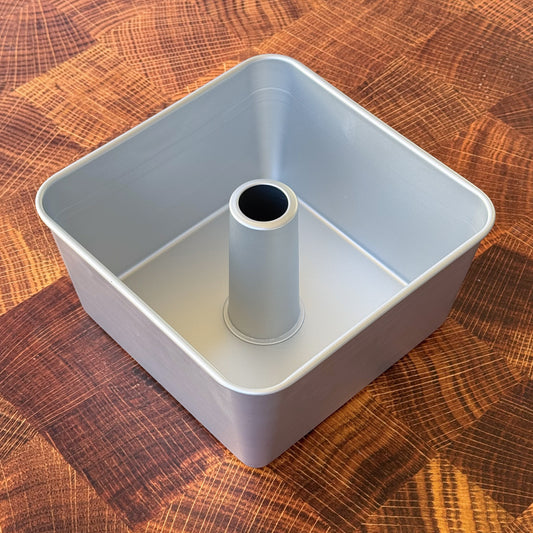
If you've been trying to decide between our one-piece and two-piece square tube pan, you're not alone. It's one of the most common questions we get and the answer comes down to what you bake most.
What makes them different?
The one-piece is a single solid pan. The two-piece has a removable bottom that lifts away from the outer piece. That removable bottom is what makes all the difference. Two-piece tube pans were originally designed for angel food cake and other sponge-based batters.
Who should get the one-piece?
If pound cakes are what you bake most, the one-piece is all you need. You coat the pan with pan coat, pour in the batter, bake, cool slightly, then flip to release. It's simple!
If you mainly bake with Bundt pans or one-piece pans and like the ease of use, go with this one.
Buying as a gift? The one-piece is the safer choice - it's what most bakers have experience with.
Who should get the two-piece?
If you also bake angel food cake, chiffon cake, sponge cake, or crumb cake, the two-piece gives you more options. It handles pound cakes just as well as the one-piece, with a couple of added advantages.
First, the design allows you to lift the cake straight up rather than inverting it, so anything with a crumb topping or a delicate crust comes out exactly as it went in. No flipping, no crushing the top.
And, if you're concerned with a cake getting stuck in the pan, the two-piece design means you can safely remove any cake in one piece.
One thing to keep in mind: thinner batters can seep through the seam between the two pieces. The fix is easy. Trace the center piece onto a square of parchment, cut it out, and slip it between the two pieces before assembling. We also like to set a baking sheet on the rack below the cake as extra insurance.
If you want a few additional advantages with a little more prep work, the two-piece pan might be for you.
So which one should you get?
Start with what you bake most. If that's pound cake, the one-piece is a great fit and keeps things simple. If you want one pan that handles a wider range of cakes and can ensure cake release, the two-piece is worth the small extra step.
If you're buying a gift, the safer bet is the one-piece, as those are more commonly used.
Either way, the Old Country Kitchenware 18-cup square tube pans are wonderful additions to a baker's kitchen.
Shop This Recipe


Benefits of the two-piece pan
Because you can lift the cake straight up rather than inverting it, anything with a crumb topping or a delicate crust comes out exactly as it went in. No flipping, no crushing the top. It's also the right choice for angel food and sponge batters, which need to hang inverted while cooling to set properly, then get cut or pulled away from the ungreased pan.
The two-piece design also means that in case a cake sticks, you can separate the two pieces to make sure the cake comes out in one piece. Let the cake cool until you can handle the pan with bare hands comfortably. Place the pan over a big can, then push down to separate the pieces. If it resists, run a thin spatula and wood skewer around the outer edges, then push down again. Slip the spatula under the cake to separate it from the center insert, then the wood skewer around the tube hole. Lift the cake off the center insert with two big knives, or invert it to drop the cake.
Lifting cakes from the two-piece pan
Preparing the one piece pan for baking
Before baking pound cake or Bundt-style cakes, you'll want to brush on pan coat, spray with baking spray, or butter and flour your pan to ensure cake release. If the batter has a lot of liquid, you may want to also line the bottom with parchment paper.
It's possible to use the one piece pan for angel food cake or sponge cake, but it's not as well suited for it as the two-piece pan. Leave the sides of the pan ungreased, but grease and line the bottom with parchment paper for easier removal. Cool the cake upside down completely, then use a skewer and thin spatula to separate the cake from the sides and tube. When you invert the pan, the cake should slide out.
Preparing the two-piece pan for baking
To prevent leaks in pound cake and thinner cake batters, insert a square of parchment paper between the two pieces. This acts like a gasket to seal the pieces of the pan together.
I usually trace the bottom of the center insert on parchment and cut it out, but since I'm making so many cakes, I bought precut 8x8" parchment squares.
Then, brush on pan coat, baking spray with flour, or butter and flour to ensure a clean release. Then when you're baking the cake, place a baking sheet on the rack below the cake to catch any potential drips (this is a good practice with any kind of pan!).
For angel food cake or sponge cake, the parchment is not necessary but good insurance just in case. It is best to leave the pan ungreased so it can cling to the sides as it rises.

Removing cake from both pans
Using two-piece cake pan for angel food cake
Leave the pan ungreased for angel food cake and sponge cake. These cakes cling to the sides of the pan as they rise, which is what gives them their structure and height. When the cake is done, you invert the pan to cool it suspended in the air, then cut the cake away from the pieces once it has cooled.




14 comments
Shirley, they’re both available on our website here at oldcountrykitchenware.com
How do i order the book and cake pan
Stacy, I hope to make our own cake and stand someday! Others have found some on Amazon
Hi…where would I find a cover and a plate big enough for mile high cake?
Audrey, I hope to make smaller versions of our square pans someday!